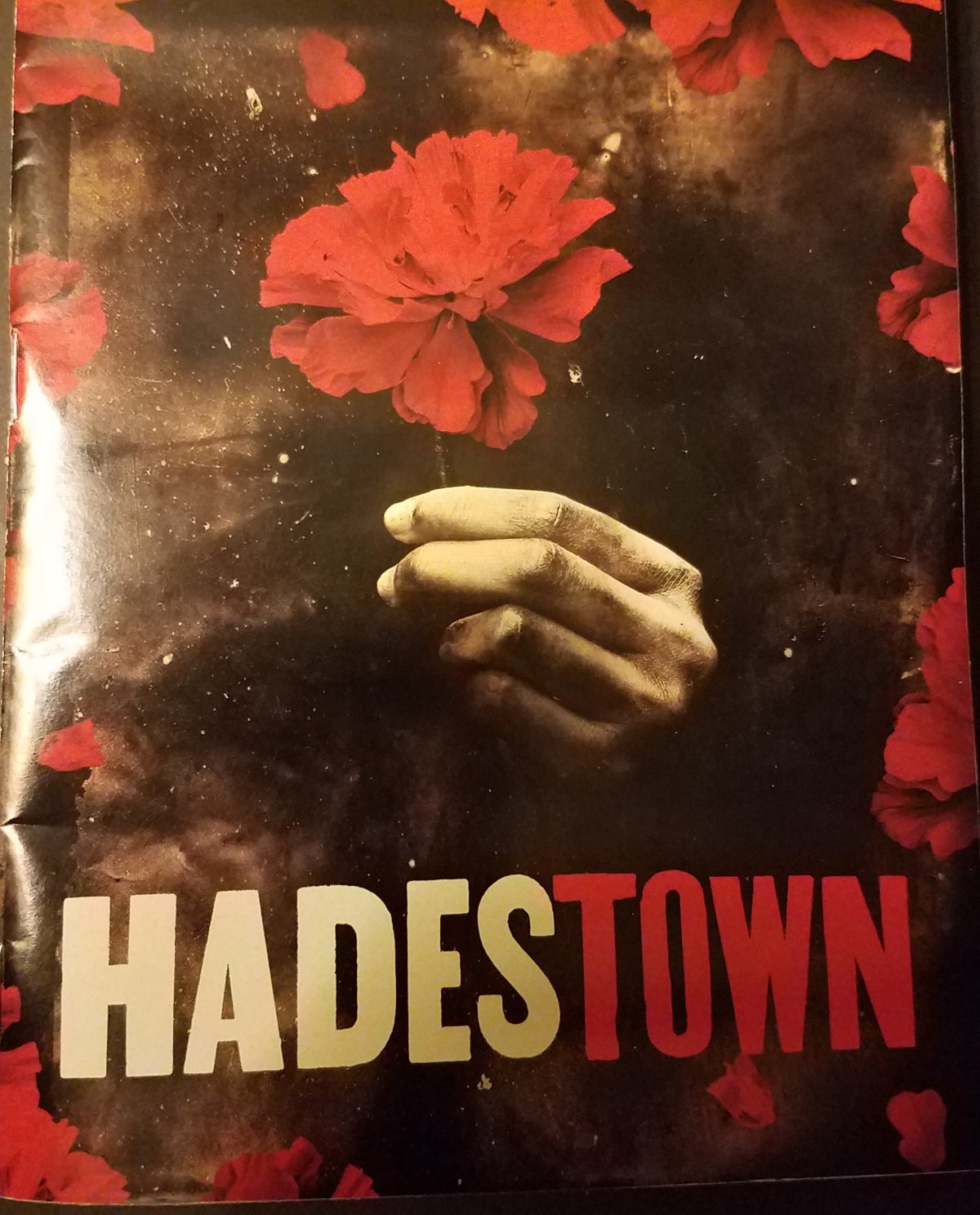
Yesterday I saw Hadestown and that’s all I’m going to write about. I’ll eschew my usual rundown of my actions and thoughts. Hadestown deserves my full attention. This is my third time seeing it on Broadway; I saw it once off-Broadway and many times as a concert piece with various casts. I’ve heard Anaïs Mitchell sing songs from it for about 15 years. You could say that I’m a fan.
This was my first time seeing it, or any play post-COVID-19. There have been some cast changes, some permanent, and some understudies subbing. Hades (Patrick Page) is now played by Tom Hewitt and there are two new Fates, Yvette Gonzalez-Nacer and Kay Trinidad have been replaced by Jessie Shelton and Marriand Torres. On the understudy Hermes was played by Oliver Reid not Tony Award winner Andre DeShields, and conductor/pianist/accordion Liam Robinson was replaced by someone whose name is not given in the program though it was said in the play when Persephone introduces the band.
The most jarring replacement was Hewitt for Page. Hewitt was great in the role, but Page IS the voice of Hades, his rumbling bass is inimical. DeShields deserved the Tony and Reid looks totally different, but he sounds similar He doesn’t quite have DeShields stage presence, but that’s an incredibly high bar. If I had not seen the original, I would have described him as magnetic and think that the original couldn’t possibly surpass him. The fact that he slips in seamlessly into the role of Hermes is a tribute not just to Reid, but also to Anaïs for writing the lines and Rachel Chavkin the director for her part in envisioning Hermes. As it’s not a speaking part most people might not even notice Liam being subbed for but he’s my friend, so it was the first thing I noticed. I didn’t know if this was permanent until I looked at the Playbill and saw that Liam is still listed in the role.
Now onto the magnificence that is Hadestown It grabs you right from the start with crowd-pleasing, audience involving opening number, The Road to Hell. I forgot how funny and how much it plays up to the crowd. This is where Hermes magnetism is essential. He’s like the emcee in Cabaret, introducing you to, and inviting you into his world The Fates are a literal Greek chorus, fortunately singing in English. They explain the action while not stopping the action. Catchy tunes will do that. Every Fates song is great. I went with Kevin, who like me is a long-time fan. In our minds the definitive fates will always be the members of Sometymes Why, Aoife O’Donovan, Ruthie Merenda, and Kristin Andreassen, who often played them in the concert versions. The roles have been reimagined since then, but I’d still love them to step in one performance on Broadway. You guys up for it?
There was a large thematic change when Hadestown came to Broadway, one that I embrace. The short synopsis of the show is “A folk opera based on the Orpheus myth set in post-apocalyptic depression era America.” As soon as I heard those words come out of Anaïs’s mouth I became a fan and knew I needed to see it. Orpheus is an archetypal tragedy. Orpheus’s fate is sealed not so much by a fatal flaw, but by the doubts all humans have. We don’t have the absolute knowledge of the gods. This production leans into that and turns it on its head. The show is now a worm ouroboros, the snake eating its own tail. The play ends with a replay of the opening. This is a perfect. It’s an echo of the intertwined Hades/Persephone myth, which is symbolic of the change of the seasons. After winter is inevitably followed by spring. On another level it mirrors the human condition. Hades says that even though the song is a tragedy we nonetheless choose to sing it, each time hoping that it will turn out differently. That’s exactly how I feel watching the show. Each time, I hope that Orpheus does not look back and Eurydice is saved. Each time he does, and she’s sent back to Hades, but that doesn’t kill the hope.

Isn’t that what all people experience. The only part of our fate that we are assured of is that out story ends with death. Yet we sing the song anyway. We live, we strive, knowing that no matter what we do, we die. People are not comfortable with that, we imagine an afterlife, we imagine re-incarnation, but we go on without knowing of such things, just imagining. Some of us go on without the imagining, but we still persevere. Mortals are greater than any god or gods. We go on in the face of our ignorance and uncertainty that would drive a god man. If there were gods, they would worship us for our endurance. It is the mortal Orpheus who transforms the gods through the power of his music. The theme of the power of music is one of the great attractions for me. The shows symbol is the rose as in the show is how we see that Orpheus’s song brings life. It is what wins the love of Eurydice. The song is the greatest power in the show’s universe, fitting for an opera or musical.
The song transforms not just the gods, but the audience. I complain that I leave too many musicals without humming the songs. I cannot leave Hadestown without whistling the music. I don’t know why it comes out as whistling, but it always does. This is not a conscious decision on my part, I just notice it in the middle of the song. It goes to the heart of my psyche. I could see the show tonight and enjoy it just as much as the first time; the hallmark of a masterpiece.
 Wise Madness